This isn't going to be one of those vague "it depends" articles that tells you nothing useful. Let's actually get into numbers, brand comparisons, and the specific things that push a price up or down.
What's a Realistic Price Range Right Now
For a working laptop that isn't ancient, you're generally looking at somewhere between ₹8,000 and ₹45,000, with most people landing in the ₹15,000–₹25,000 zone for a decent i5 machine with 8GB RAM and an SSD. Below ₹8,000, you're usually buying something with an old processor and a spinning hard drive, fine for very basic use, not great for anything else. Above ₹45,000, you're already in territory where a refurbished business laptop or an entry MacBook starts to make more sense than a random secondhand listing.
The old laptop price you see quoted by an individual seller tends to run lower than what a certified seller charges, but that gap exists for a reason. More on that in a bit.
Price by Processor Generation
This is probably the single biggest factor in used laptop price, more than brand even.
- i3, 4th-6th gen: ₹6,000-12,000 — fine for browsing, documents, basic office work
- i5, 6th-8th gen: ₹12,000-22,000 — the sweet spot for students and general professional use
- i5, 10th gen and above: ₹20,000-32,000 — noticeably snappier, handles multitasking well
- i7, 6th-8th gen: ₹18,000-28,000 — good for slightly heavier work, some light editing
- i7, 9th gen and above: ₹28,000-45,000+ — this is where you start getting real performance for design work, coding, moderate gaming
If someone's selling you a refurbished i5 laptop or i7 unit for way below these ranges, either the battery is shot, the screen has issues, or it's an ancient generation being passed off as recent. Always ask the exact generation, not just "i5" or "i7", a 4th gen i5 and a 10th gen i5 are not remotely the same laptop.
Price by Brand
Brand affects resale and pricing more than people expect, mostly because of build quality reputation and parts availability.
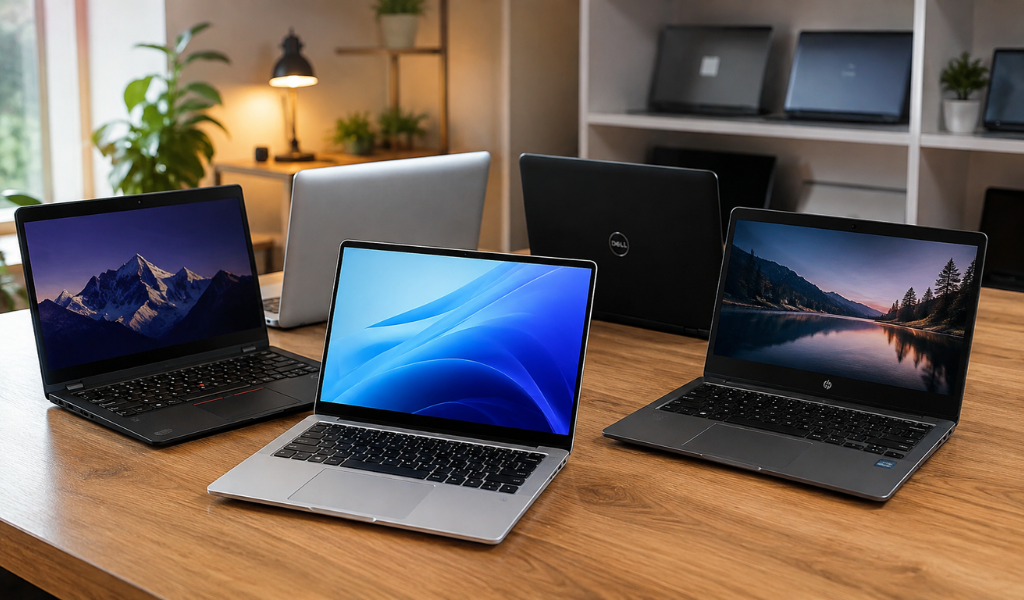
Dell business laptops (Latitude, OptiPlex desktops too) hold their price reasonably well because IT departments trust them and parts are easy to find. A Dell laptop 25000 budget usually gets you a solid i5, 8GB RAM, decent battery health unit from LapEasy in Grade B or C condition.
Lenovo, especially ThinkPads, tend to sit slightly cheaper than Dell for the same specs, purely because they're less flashy-looking, even though the actual hardware durability is arguably better. If you want performance per rupee, Lenovo refurbished units are often the better buy.
HP sits somewhere in between, decent pricing, wide availability, good for general use without needing the ThinkPad-level toughness.
Apple is a different game entirely. A refurbished MacBook rarely drops below ₹20,000 even for older models, because Apple hardware simply holds value longer than Windows laptops. If you're comparing a refurbished MacBook Air against a similarly priced Windows ultrabook, know that you're not really getting equivalent specs for the money, you're paying for the ecosystem and build quality.
What Actually Moves the Price Up or Down
A few things swing price more than people realize:
RAM and storage type matter a lot, an 8GB RAM, SSD-equipped laptop will always cost more than a 4GB RAM, HDD version of the exact same model, sometimes by ₹3,000-5,000. If your budget is tight, upgrading RAM yourself later is often cheaper than paying extra upfront for a pre-upgraded unit.
Battery health is the quiet price killer. Two identical laptops, same specs, same look, but if one has 85% battery health and the other has 55%, that's an easy ₹2,000-4,000 difference, and it should be. Always ask for the battery report before agreeing on price.
Cosmetic grade plays in too, a Grade A unit costs more purely for looking better, not performing better. We've written a full breakdown on this if you want to understand grading in depth.
Warranty changes the equation completely. A laptop with zero warranty from an individual seller might look cheaper on paper than the same specs from a certified seller offering 6-12 months coverage, but factor in the risk of paying for repairs out of pocket, and the "cheaper" option often isn't cheaper at all.
Why Prices Vary So Much Between Sellers
Here's the honest truth: two sellers can list the exact same laptop model at prices ₹5,000 apart, and it's not always a scam on either end. A certified refurbisher tests 20-40 parameters, replaces worn parts, cleans internals, and backs the sale with warranty, that process costs money, and it's reflected in the price. An individual selling their old laptop online skips all of that, which is why it looks cheaper, until something breaks in month two and you're on your own.
If you're buying second hand laptop online from an individual, at minimum insist on an in-person check or a detailed video call inspection before paying. If you're buying from a certified platform, you're paying a bit more for that testing and warranty upfront, but you're not gambling on hidden problems.
A Quick Sanity Check Before You Pay
If a listed price feels too good for the specs mentioned, there's almost always a catch, swapped battery, cracked internals not visible in photos, or a processor generation that's older than advertised. On the flip side, if a seller is charging near-new prices for a laptop that's several years old, that's your cue to negotiate or just walk away and check what similar specs go for elsewhere first.
Knowing these ranges puts you in a much stronger position, whether you're negotiating with an individual seller or comparing listings from used laptops near me searches. You stop guessing and start actually evaluating what you're being offered.
FAQ's
1. What is a fair price for a 2nd hand laptop?
For a decent working laptop with an i5 processor, 8GB RAM, and SSD, a fair price generally falls between ₹15,000 and ₹25,000, depending on the processor generation and cosmetic condition.
2. Why do refurbished laptops cost more than random secondhand ones?
Refurbished laptops go through testing, part replacement, and quality certification, and they usually come with a warranty, that process adds cost but also removes most of the risk you'd take on buying from an individual seller.
3. Does battery health affect 2nd hand laptop price?
Yes, significantly. A laptop with battery health above 80% will typically cost more than the same model with battery health below 60%, since replacing a battery adds extra expense later.
4. Is buying a used laptop online safe price-wise?
It can be, as long as you buy from a certified seller with a warranty and return policy. If you're buying from an individual, always verify the actual condition and battery health before agreeing on price.
5. What's the price difference between i5 and i7 refurbished laptops?
Generally there's a ₹5,000-10,000 gap between comparable generations of i5 and i7 processors, though an older i7 can sometimes cost similar to a newer i5, always compare generation, not just the processor name.